Immersive Learning
for the Next Generation.

Transform education from passive instruction into immersive, hands-on experiences — where students don’t just learn, but explore, experiment, and apply knowledge in meaningful ways.

Schedule a Demo

When Curiosity Meets Limitation

Students are naturally curious. They want to explore, test, and understand how things work. Yet traditional learning environments often limit how far that curiosity can go.

Limited access to labs and specialised equipment

High costs of building and maintaining training facilities
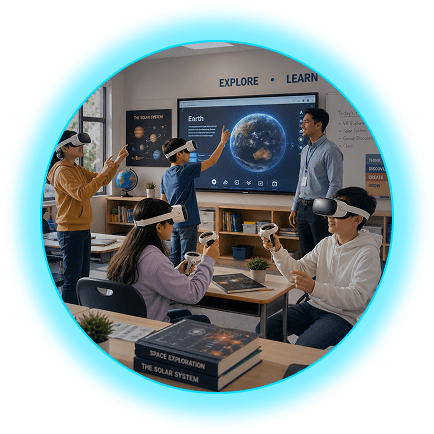
Students exploring immersive learning with VR

Safety risks in experiments and technical procedures

Difficulty visualising complex or abstract concepts

As education evolves, institutions are seeking new approaches — moving beyond passive learning, toward active, experiential education.

From Passive Learning
to Intelligent Experiences

We combine XR with Spatial AI to create intelligent learning environments — where students don’t just see content, but interact with systems that respond, guide, and adapt in real time.

Our Approach: Learning by Experiencing

From Understanding Concepts to Experiencing Them.

What if students could step inside a chemical reaction — instead of just reading about it?

Or safely operate complex machinery before entering the real world?

At Silversea Media, we design immersive learning environments powered by XR — enabling students to learn by doing, not just observing.

What this Enables

  1. 01
    Explore Complex Concepts

    Interact with simulations that make abstract ideas visible and intuitive.

  2. 02
    Practice in Safe Environments

    Perform real-world procedures without risk or consequences.

  3. 03
    Visualise What’s Hard to Explain

    Understand systems, processes, and structures beyond textbooks.

  4. 04
    Build Real-World Readiness

    Gain hands-on experience before entering actual workplaces.

The Outcome

Students move beyond passive observation and:

  • Actively participate in their learning journey
  • Build confidence in applying knowledge
  • Gain practical, hands-on skills
  • Develop deeper understanding of complex concepts
  • Prepare effectively for real-world challenges

Virtual Labs
Without Limits

Experiment Freely. Learn Safely.

Bring laboratory experiences into fully immersive digital environments — accessible anytime, anywhere.

Students can conduct experiments, interact with equipment, and learn through trial and error without real-world risks.
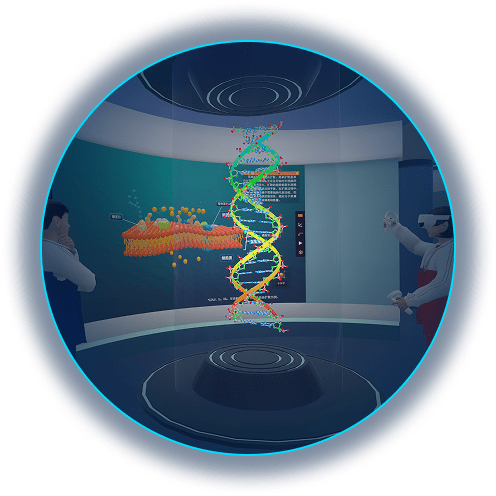
Virtual lab with DNA simulation
  • Safe trial-and-error learning environments
  • Virtual science and engineering experiments
  • High-risk procedures performed without danger
  • Interactive 3D lab equipment and simulations

Interactive Digital Content

Interactive Lessons That Come Alive, from Content to Experience

Turn static lessons into immersive, interactive learning journeys with 2D and 3D content. Seamlessly integrates with your current systems to elevate learning without disruption.
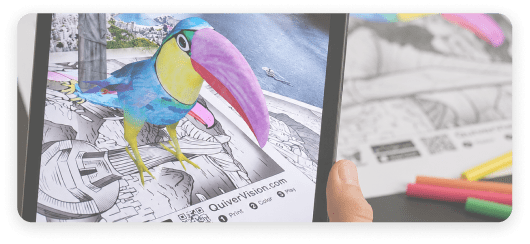
AR-enhanced textbook experience

Smarter Learning Content

  • AR-enhanced textbooks that bring concepts to life
  • 360° interactive exploration of subjects
  • Ideal for K-12 and foundational learning
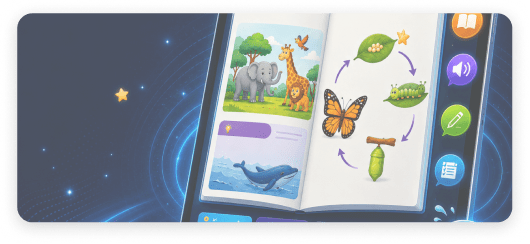
Story-driven immersive learning

Immersive, Story-Driven Learning

  • Lessons delivered like interactive experiences
  • Students make decisions and explore outcomes
  • Encourages critical thinking and problem-solving
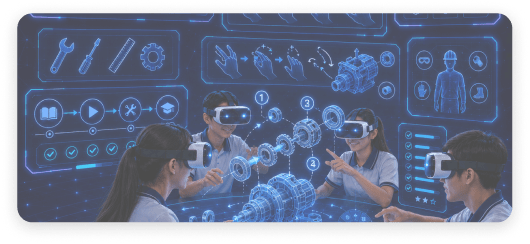
Blended physical and digital learning

Blended Physical & Digital Learning

  • Real-world environments enhanced with digital layers
  • Hands-on, interactive exploration beyond traditional classrooms

XR Content Development

Real-World Training, Without Real-World Risk

Simulate real-world environments where students can safely learn, make mistakes, and improve.

01

Operate machinery and systems in a safe environment.

02

Explore detailed 3D workflows and operational processes.

03

Scenario-based training (e.g. emergency response, industrial operations).

04

Multi-user collaboration in shared simulations.

05

Performance tracking with actionable educator feedback.

06

Accessible across VR headsets, tablets, and desktops.

Virtual Campus

Your Campus, Reimagined

Create fully immersive 3D campuses where learning extends beyond physical boundaries. Students can explore virtual campuses, classrooms, and labs, enabling education to be more accessible, interactive, and connected across different locations.

  • Interactive navigation of buildings, classrooms, and facilities
  • Fully digital twin of real-world campus environments
  • Scalable deployment across multiple campuses or institutions
  • Centralised campus experience accessible anytime, anywhere

AI-Powered Metaverse Learning Space

Adaptive Learning in Virtual Worlds

Create an intelligent metaverse-based learning environment where teaching and learning happen inside fully interactive 3D spaces. This is not a campus replica, but a dynamic learning ecosystem designed for collaboration, exploration, and AI-enhanced education.

AI-assisted learning and real-time contextual guidance

Immersive 3D learning environments for different subjects

Real-time collaboration between students and educators

Spatial visualisation of abstract and complex concepts

Adaptive learning experiences based on student interaction and performance

FAQ illustration

FREQUENTLY ASKED QUESTIONS

Augmented reality blends digital elements with the real world, letting you see and interact with virtual content in a natural way. It can be used for learning, exploring, or creating immersive experiences that connect the physical and digital worlds.
AR adds digital information on top of the real world instead of replacing it entirely. Users can still see their physical surroundings while interacting with contextual instructions, data, or 3D visuals that support operational tasks.
Augmented reality can act as an interface for Spatial AI systems. When AR is connected to digital twins and real-world data, users can interact with intelligent digital environments layered over the physical world. This allows organisations to visualise infrastructure, training, and simulate workflows in ways that are far more intuitive than traditional dashboards or manuals.
AR is effective for training because it enables visualization of digital content within the actual working environment. It allows staff to practise procedures in realistic, simulated environments without exposure to real-world risks. It is especially effective for safety training, equipment handling, and emergency response.
AR improves operational efficiency by providing real-time overlays and guided workflows directly within the physical environment. This helps teams perform tasks more accurately, access information instantly, and reduce errors during inspections, maintenance, and daily operations.
AR is used to create interactive and immersive experiences that engage audiences more effectively. This includes virtual product visualisation, interactive exhibitions, brand activations, and AR-powered showrooms that allow users to explore products and environments in a more engaging way.
Today, businesses are increasingly adopting augmented reality solutions because it can improve training effectiveness, reduce operational errors, and make complex systems easier to understand. AR presents information directly within the working environment to help teams learn procedures more quickly and perform tasks with greater confidence.
Not necessarily. Augmented reality is most effective in environments where processes are complex, information is difficult to interpret, or operational risks are high. In these situations, AR can improve clarity and decision-making by presenting information directly within the working context.
Silversea Media begins by analysing operational workflows and identifying areas where teams encounter uncertainty, delays, or inefficiencies. Based on these insights, we design augmented reality solutions to address real operational challenges in a tailored approach.
Augmented reality is widely used in industries such as training and education, facilities and operations management, manufacturing, healthcare, and marketing experiences. It can also be highly effective for events and exhibitions where interactive engagement enhances audience understanding.
The MetaTwin 3D platform is an integrated system that connects spatial scanning, digital twins, augmented reality, and virtual reality into a unified interactive environment. This allows organisations to visualise physical spaces digitally and interact with them for training, planning, and operational analysis.
Clients can check that their AR solution is actually working through data tracking, usage statistics, efficiency, and how much traffic is being brought to events and shops. These indicators help determine whether the technology is improving performance and delivering measurable value.