AI-Enabled Digital Twin for
Built Environment Transformation

Reimagining the built environment with Digital Twin, XR, and Spatial AI. Silversea Media helps facility teams gain real-time visibility, predictive insights, and immersive tools to improve safety, efficiency, and sustainability.

Schedule a Demo

KEY CHALLENGES

Modern buildings are complex to manage.

Facility teams often work across disconnected systems, data silos, reactive maintenance processes, and complex physical environments.

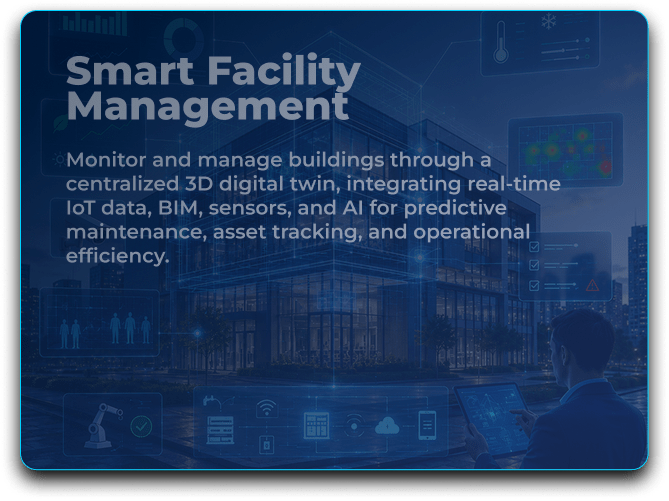
Silversea Media's Digital Twin platform combines BIM, 3D models, real-time IoT data, historical analysis, and Spatial AI intelligence to create a dynamic, connected view of buildings.
Fragmented building systems

Systems, assets, and operational data are often separated across different platforms.

Reactive maintenance

Issues are addressed only after they occur, creating downtime and higher operating costs.

Limited lifecycle visibility

Teams lack a unified view from planning and construction through operations and redevelopment.

Complex environments

Large buildings and campuses are difficult to inspect, train for, operate, and optimise at scale.

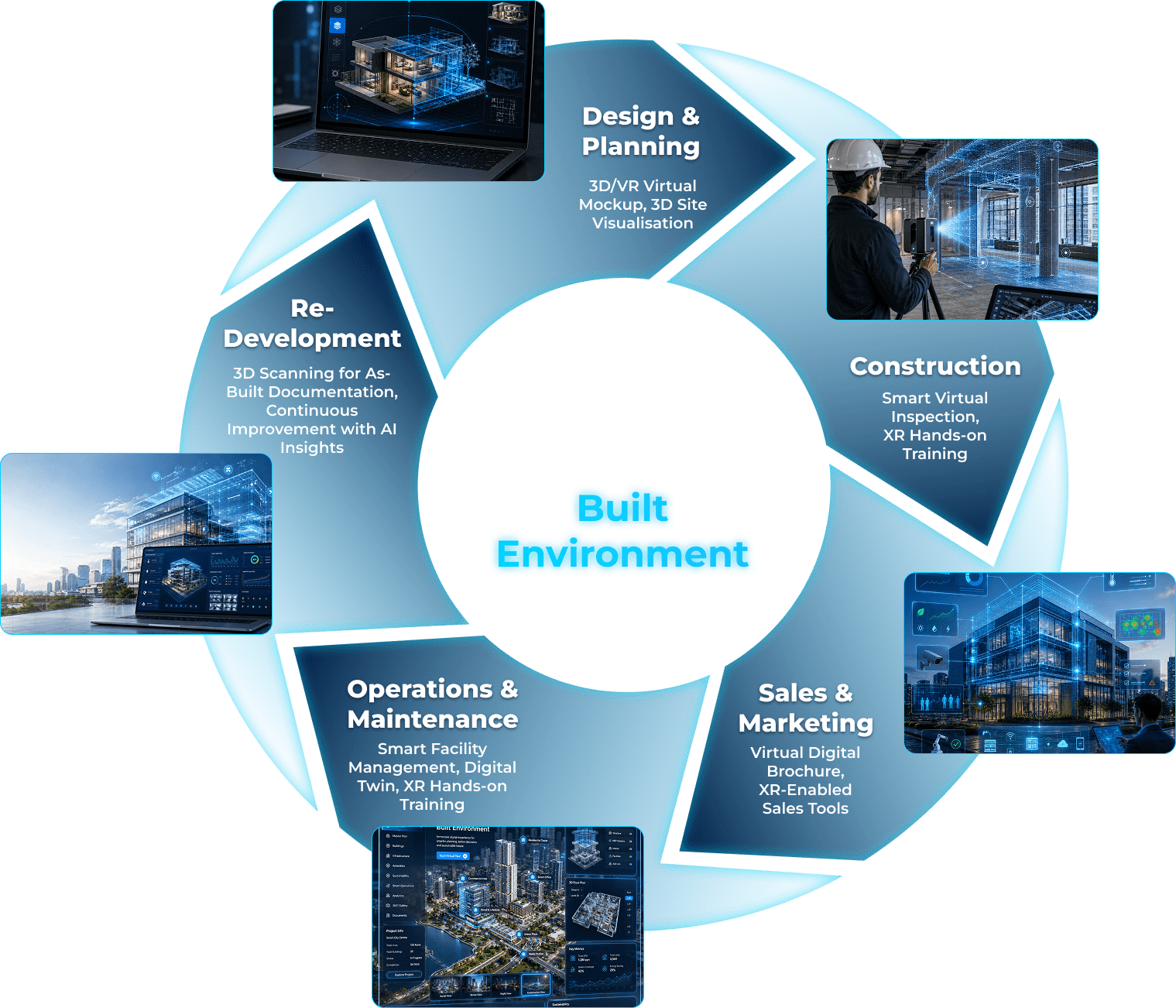
AI-enabled Digital Twin for Built Environment lifecycle

How Silversea Media’s Solution Helps

Silversea Media delivers an end-to-end Digital Twin and Spatial AI ecosystem that connects data, people, and processes across the entire built environment lifecycle. By integrating building system data, real-time IoT inputs, XR experiences, and smart inspection workflows, organisations can transition from reactive building management to proactive, intelligent Smart Facility Management.

Areas of Application

We transform buildings and campuses into living Digital Twins enhanced by Spatial AI, evolving from planning through operations. Instead of isolated models or dashboards, stakeholders gain a unified, intelligent view—a single source of truth that reflects real-world conditions, asset status, and operational performance in real time.

Smart Building
Smart Cities
Data Centers
Smart Industrial Park
Smart Transport Hubs
Smart Campus
Smart Factory
Smart Warehouses
FAQ illustration

FREQUENTLY ASKED QUESTIONS

Augmented reality blends digital elements with the real world, letting you see and interact with virtual content in a natural way. It can be used for learning, exploring, or creating immersive experiences that connect the physical and digital worlds.
AR adds digital information on top of the real world instead of replacing it entirely. Users can still see their physical surroundings while interacting with contextual instructions, data, or 3D visuals that support operational tasks.
Augmented reality can act as an interface for Spatial AI systems. When AR is connected to digital twins and real-world data, users can interact with intelligent digital environments layered over the physical world. This allows organisations to visualise infrastructure, training, and simulate workflows in ways that are far more intuitive than traditional dashboards or manuals.
AR is effective for training because it enables visualization of digital content within the actual working environment. It allows staff to practise procedures in realistic, simulated environments without exposure to real-world risks. It is especially effective for safety training, equipment handling, and emergency response.
AR improves operational efficiency by providing real-time overlays and guided workflows directly within the physical environment. This helps teams perform tasks more accurately, access information instantly, and reduce errors during inspections, maintenance, and daily operations.
AR is used to create interactive and immersive experiences that engage audiences more effectively. This includes virtual product visualisation, interactive exhibitions, brand activations, and AR-powered showrooms that allow users to explore products and environments in a more engaging way.
Today, businesses are increasingly adopting augmented reality solutions because it can improve training effectiveness, reduce operational errors, and make complex systems easier to understand. AR presents information directly within the working environment to help teams learn procedures more quickly and perform tasks with greater confidence.
Not necessarily. Augmented reality is most effective in environments where processes are complex, information is difficult to interpret, or operational risks are high. In these situations, AR can improve clarity and decision-making by presenting information directly within the working context.
Silversea Media begins by analysing operational workflows and identifying areas where teams encounter uncertainty, delays, or inefficiencies. Based on these insights, we design augmented reality solutions to address real operational challenges in a tailored approach.
Augmented reality is widely used in industries such as training and education, facilities and operations management, manufacturing, healthcare, and marketing experiences. It can also be highly effective for events and exhibitions where interactive engagement enhances audience understanding.
The MetaTwin 3D platform is an integrated system that connects spatial scanning, digital twins, augmented reality, and virtual reality into a unified interactive environment. This allows organisations to visualise physical spaces digitally and interact with them for training, planning, and operational analysis.
Clients can check that their AR solution is actually working through data tracking, usage statistics, efficiency, and how much traffic is being brought to events and shops. These indicators help determine whether the technology is improving performance and delivering measurable value.