What Is Spatial AI? How It Works for Businesses in Singapore
Spatial AI is a technology that enables machines to understand, analyse, and interact with real-world environments in three dimensions using data, sensors, and artificial intelligence.
In this technologically advanced era, Spatial AI is not treated as a standalone concept. It forms part of a broader ecosystem that integrates digital twins, XR technologies, and real-time operational data into a unified platform. This allows organisations to move beyond static visualisation and work within intelligent, responsive environments that reflect how real spaces behave.
If your organisation is exploring ways to improve operational efficiency, training outcomes, or facility management, this guide will help you make the right decisions. Read on to find out what spatial AI is and how it is used in businesses.
What is Spatial AI and Why Is It Important for Businesses
Spatial AI systems go beyond just processing data in isolation; they interpret how objects, spaces, and environments relate to one another.
This capability is increasingly important as organisations deal with complex infrastructure, distributed teams, and evolving operational demands.
Benefits of Spatial AI for Organisations
Spatial AI offers many benefits to organisations as it allows them to gain interactive, real-world insights.
Improved Operational Efficiency
Because Spatial AI allows teams to visualise workflows and environments in 3D, businesses can easily identify bottlenecks, streamline their processes, and optimise how to use their resources. Thus, they don’t just rely on assumptions; they have insights into how the system will behave in real situations.
Reduced Costs Over Time
Spatial AI allows scenarios to be simulated before the actual implementation. This way, organisations can avoid costly mistakes and reduce unnecessary downtime. Also, with predictive maintenance and better resource allocation, businesses can minimise operational expenses in the long run.
Better Decision-Making
Spatial AI provides insights into real-time data and realistic simulations, allowing businesses to get a clearer understanding of their operations. They can then be in a better position to make more informed, confident decisions in terms of planning infrastructure, improving workflows, or managing assets.
Spatial AI vs Traditional AI
| Traditional AI | Spatial AI |
| Analyses data | Understands environments |
| 2D dashboards | 3D environments |
| Static insights | Real-time simulation |
What Is Spatial Intelligence in AI — Real-World Applications
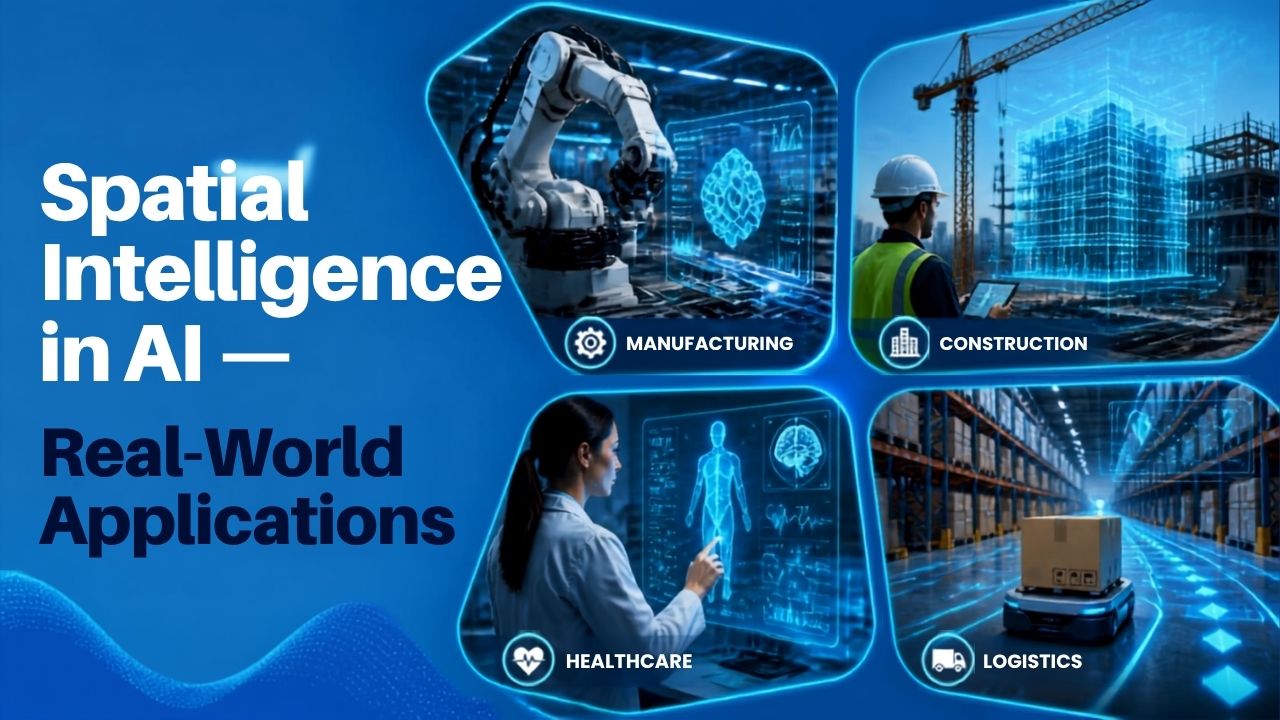
Spatial intelligence in AI allows organisations to move from observation to simulation and optimisation.
Instead of reviewing static reports or 2D dashboards, teams can:
- Visualise entire facilities in interactive 3D environments
- Analyse workflows and operational bottlenecks spatially
- Simulate scenarios before implementing changes
- Monitor assets and infrastructure in real time
This approach is particularly valuable in industries where spatial awareness is critical, such as:
- Manufacturing
- Construction
- Healthcare
- Logistics
When spatial data is connected to AI models, organisations gain insights that are not easily visible through traditional analytics.
How Businesses Use Spatial AI in Singapore
The value of Spatial AI becomes clear when it is applied to specific operational challenges.
In practice, organisations use Spatial AI to improve:
- Training and Safety - Teams can train in realistic virtual environments that replicate real-world conditions. This reduces risk while improving knowledge retention.
- Facility Management - Digital twins powered by Spatial AI allow managers to monitor infrastructure, track assets, and plan maintenance more effectively. This can reduce downtime and improve resource allocation.
- Operational Planning - By simulating workflows and processes within spatial environments, organisations can identify inefficiencies before they occur. This leads to more efficient operations and lower operational costs.
- Decision-Making - Spatial AI provides a clearer understanding of how systems behave over time. This helps stakeholders make decisions based on realistic simulations rather than assumptions.
Challenges of Implementing Spatial AI
Although there are many benefits of Spatial AI, there are certain challenges involved when it comes to Spatial AI adoption. These typically include the initial costs, especially for data capture and system setup.
Then you will also have to see how the solutions will be integrated with existing systems, which can require careful planning to ensure compatibility.
Moreover, the technical complexity of combining spatial data, AI models, and 3D environments means that you need the right expertise to implement solutions effectively.
How Spatial AI Works with Digital Twins
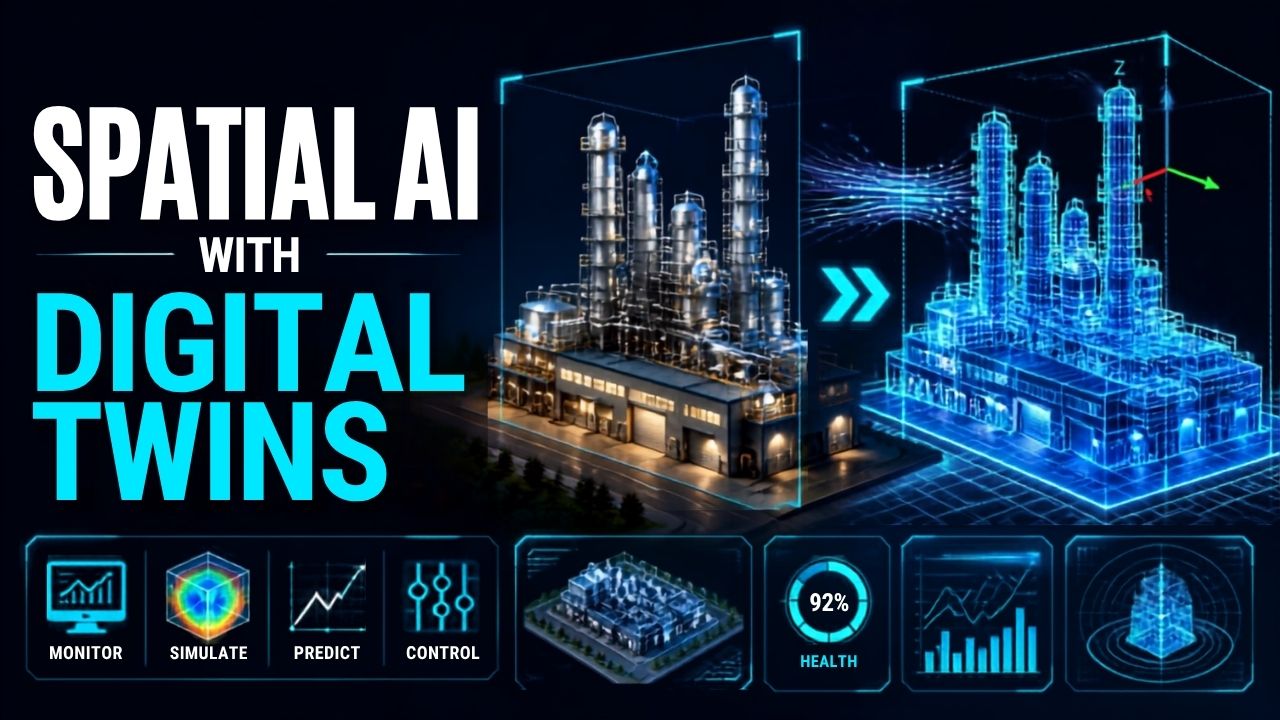
Spatial computing AI becomes significantly more powerful when combined with digital twins. Modern Spatial AI systems are designed to integrate seamlessly with digital twins, creating environments that mirror real-world conditions with high accuracy.
These systems allow organisations to:
- Explore facilities remotely with full spatial context
- Test operational changes before implementation
- Analyse performance data within a 3D environment
- Improve collaboration across teams and locations
How Businesses in Singapore Are Using Spatial AI
Spatial AI is being used across a wide range of industries, especially those where understanding and managing physical environments is essential. Instead of relying on static data or 2D dashboards, businesses can leverage Spatial AI to get a realistic view and understanding of operations.
The following industries use Spatial AI in some form or another:
Manufacturing and Industrial Operations
Spatial AI is especially useful in monitoring production environments in manufacturing and industrial operations. Businesses can optimise workflows and identify inefficiencies before they affect output.
Built Environment and Real Estate
In such industries, businesses rely on Spatial AI to visualise properties, manage infrastructure, and plan maintenance more effectively. These Spatial AI solutions are used by developers and facility managers to improve their productivity and efficiency.
Healthcare and Medical Training
This is where the real power of Spatial AI can be put to good use. Hospitals and training institutions can use immersive environments to simulate real-world scenarios for training purposes and to gain valuable experience. The result is that training outcomes are improved, along with patient safety.
Logistics and Supply Chain
Optimising workflows, inventory management, and operational efficiency are critical in the logistics and supply chain industries. Spatial AI can help businesses track assets, optimise warehouse layouts, and improve operational efficiency across complex supply networks.
Education and Technical Training
Schools and training centres can use Spatial AI to create interactive learning environments, making it easier for students to understand complex concepts through real-world simulation. This helps provide greater opportunities for training and education in real-world scenarios.
What to Look for in a Spatial AI Provider
While choosing a Spatial AI solutions provider in Singapore, opt for those who focus on delivering Spatial AI solutions that are both technically advanced and operationally practical. Check to see that:
- Solutions are fully customised to specific operational needs
- Systems integrate with existing workflows rather than replacing them
- Technologies are designed for long-term usability and scalability
- Projects are supported end-to-end, from strategy to deployment
How to Get Started with Spatial AI
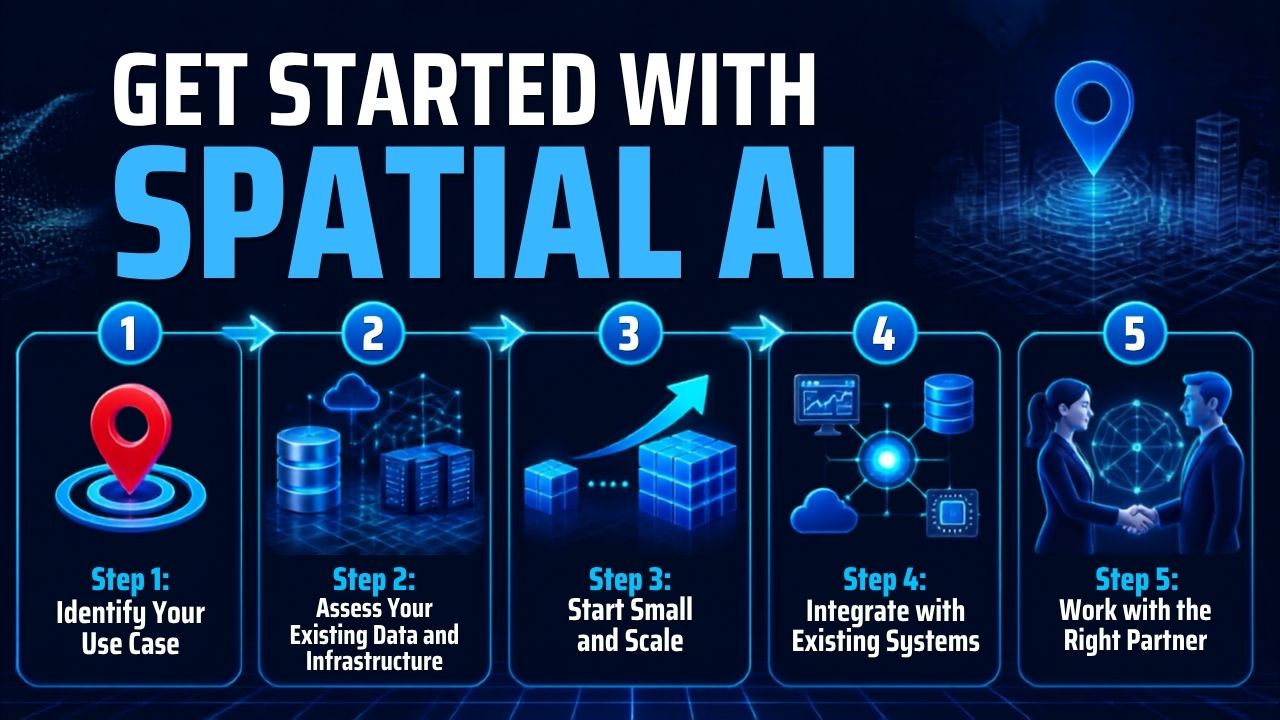
To get your business started with Spatial AI solutions, you need to follow the following steps:
Step 1: Identify Your Use Case
The first step is to identify where Spatial AI can be the most useful to you. This could be anything ranging from improving training, optimising workflows, enhancing facility management, or enabling better decision-making through simulations. Depending on this use case, the exact solutions will be mapped to align with your business goals.
Step 2: Assess Your Existing Data and Infrastructure
Spatial AI requires accurate spatial data for the best performance. These include floor plans, 3D models, or operational data related to your business. They may need to be captured through technologies such as LiDAR scanning.
Step 3: Start Small and Scale
This is a rather important step. Instead of implementing a full-scale solution at the start, you should aim to focus on a pilot project first. This approach can help you test the technology, measure the impact of the solution, and refine it, if required, before scaling across the organisation.
Step 4: Integrate with Existing Systems
Ideally, Spatial AI should not replace your current systems. Rather, Spatial AI should work alongside your current tools and workflows. Through this integration, you can ensure that insights from spatial data can be applied directly to operations, rather than existing in isolation.
Step 5: Work with the Right Partner
Lastly, make sure that you work with the right partner that has the required technical expertise and a clear understanding of business objectives. This ensures that the Spatial AI solutions are not only technically sound but also aligned with real operational needs.
Providers like Silversea Media focus on delivering practical, scalable Spatial AI solutions tailored to specific business challenges.
Explore Spatial AI for Your Organisation
Spatial AI is no longer limited to research or experimental use. It is now a practical tool that helps organisations understand, manage, and optimise their environments. If your organisation is looking to improve training, streamline operations, or enhance decision-making, Spatial AI offers a clear and effective path forward.
Frequently Asked Questions
1. What is Spatial AI in simple terms?
Spatial AI refers to technology that allows machines to understand and interact with physical spaces in three dimensions, using data, sensors, and artificial intelligence.
2. How does Spatial AI differ from traditional AI?
Traditional AI focuses on data analysis, while Spatial AI adds an understanding of physical space, enabling interaction with environments and objects.
3. What is spatial intelligence in AI?
Spatial intelligence in AI is the ability to interpret spatial relationships between objects and environments, allowing for better simulation and decision-making.
4. How is Spatial AI used in businesses?
Businesses use Spatial AI for training, facility management, operational planning, and improving decision-making through realistic simulations.
5. What industries benefit most from Spatial AI?
Industries such as manufacturing, healthcare, construction, logistics, and education benefit significantly due to their reliance on physical environments.
6. How does Spatial AI improve training outcomes?
It enables immersive training environments where users can practise tasks safely, leading to higher retention and reduced real-world risk.
7. What is the role of digital twins in Spatial AI?
Digital twins provide a virtual representation of physical assets, which Spatial AI enhances with analysis, simulation, and real-time data integration.
8. How much do Spatial AI solutions cost in Singapore?
Costs vary depending on scope, but scalable solutions allow organisations to start small and expand based on needs and ROI.
9. Can Spatial AI integrate with existing systems?
Yes, modern Spatial AI solutions are designed to integrate with existing workflows, data systems, and operational tools.
10. What is the future of Spatial AI in Singapore?
Spatial AI is expected to play a key role in automation, smart infrastructure, and digital transformation as organisations increasingly rely on intelligent environments.