VR Galleries for Businesses: Benefits, Costs & Real-World Applications in Singapore
Why Singapore Businesses Are Exploring VR Galleries
How do you walk a client through a facility that hasn't been built yet? Or train employees on equipment that's still on a drawing board?
As part of the country’s Smart Nation initiative, businesses across various industries are trying out immersive technologies and learning how to better plan projects, train employees, and communicate complex ideas without the need for endless presentations.
Factories are trying out how they might simulate the environment before even installing the machinery. Architecture and engineering companies are using immersive technology to review building designs together.
One concept popping up in these conversations is the VR gallery Singapore businesses are starting to explore. It’s a digital space where you experience information instead of just looking at it.
In this article, we’ll walk through what VR galleries actually are in a business context, how companies are using them today, what they cost to build, and how organizations measure their real-world impact. This article is specifically about VR gallery solutions for businesses in Singapore, not public entertainment venues.
What Exactly Is a VR Gallery in a Business Context?
Moving Beyond the Idea of a ‘Virtual Exhibition’
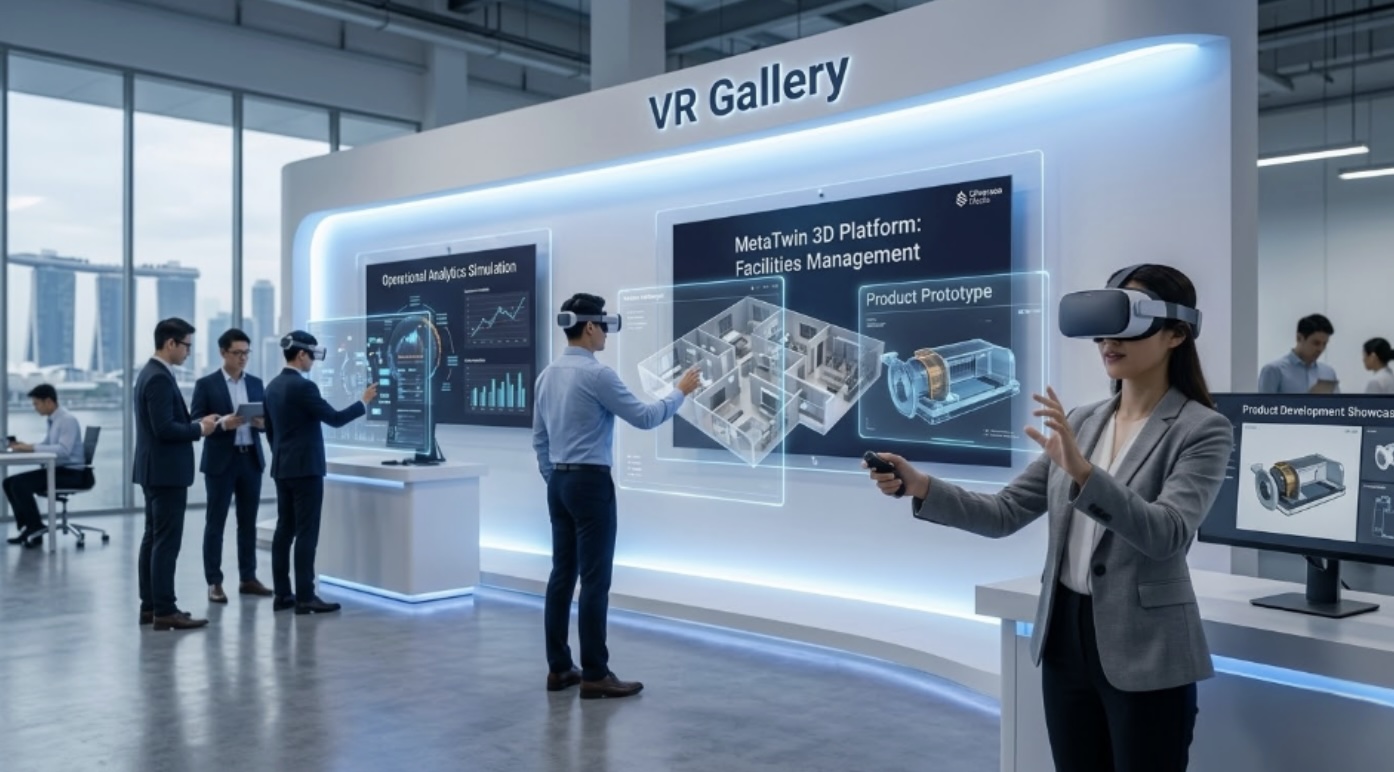
A VR gallery is an immersive digital environment where businesses present products, infrastructure, or workflows in spatial 3D environments that users can explore using VR headsets or browser-based interfaces.
Rather than scrolling through presentations, imagine walking inside the information itself.
This is especially the case for companies working with complex information, factories, infrastructure, and technology. The spatial understanding of the information completely redefines the way they approach their business. Teams can walk through a design together, spot issues, and argue about fixes in real time, all before anyone breaks ground.
Why the Concept Is Gaining Attention in Singapore
Through initiatives tied to the Smart Nation vision, organizations are getting nudged to experiment with tools that could actually make them more productive.
Consumer-facing stuff has helped too. The art science museum VR gallery, for instance, showed people what immersive environments can do. But the real growth isn't in museums—it's behind the scenes, inside companies using this stuff to solve actual business problems.
Why Businesses Are Turning to VR Galleries
Visualizing Complex Environments Before They Exist
A lot of business decisions come down to picturing something that isn't there yet.
A VR gallery lets a team step inside those plans long before construction starts. Within a VR gallery, digital twin models can recreate spaces in remarkable detail; engineers, designers, and even executives can walk through, spot problems, and fix them while it's still cheap.
Spotting a design flaw in a virtual environment is far easier, and far cheaper, than fixing it after construction has started.
Training without Operational Disruption
Training is another obvious place where this stuff shines.
A VR gallery might be designed to replicate the machinery, safety procedures, and even maintenance processes in a controlled environment. Employees might become familiar with the process even before they lay hands on the actual thing.
Creating High-Impact Client Experiences
When selling something complex, like a piece of industrial equipment or a building, the standard sales tools of presentation and brochure are insufficient. An immersive environment allows the client to walk around the product, inspect the details, and observe the product in action.
Supporting Remote Collaboration
No longer do most teams work in the same place.
If your team spans Singapore, Tokyo, and London, how do they review the same prototype together?
A VR gallery solves that. Everyone is in the virtual space at the same time, regardless of their location in the world.
Real-World Enterprise Applications
Manufacturing and Industrial Training
If you were to walk into most manufacturing facilities these days, you’d probably see a stack of training manuals, a few diagrams on the wall, and maybe a veteran worker explaining the basics to a new hire.
But what if you could walk through the same space before it was built, identifying safety hazards that don’t yet exist, and testing equipment layouts while the floor is still wet and the concrete is still in the mixing trucks. All this, and you’re still in a meeting room several miles away.
That's what a VR gallery makes possible in industrial training.
For manufacturers in Singapore—competing in a world of automated supply chains—these tools are quickly becoming essential, not optional.
VR Galleries for Interactive Product Showrooms
Take automotive companies. Some companies are also creating VR showrooms where customers can view cars in three-dimensional format. For instance, there’s an experience center in Asia that offers a customer the option to select a car through a touchscreen, and then a full-scale virtual version of the car is displayed on a huge screen, followed by a virtual test drive of the car.
Others are going fully remote. Several luxury brands now offer browser-based showrooms that mirror their physical dealerships—minus the sales pressure.
That's the point: a VR gallery turns passive looking into interactive exploring.
Corporate Events and Innovation Demonstrations
We’re seeing immersive environments being used at corporate events and tech demos.
The infrastructure is also catching up fast. The telecom industry in Singapore is already testing ultra-high-speed fiber cables that will support immersive tech. This means that real-time collaboration within immersive environments will soon become a breeze for companies in the region.
Across industries like manufacturing, utilities, automotive retail, the pattern keeps showing up. Companies exploring VR gallery solutions in Singapore are using them to visualize operations, train people, and explain complex ideas in ways old tools just can't.
Of course, the option of building immersive environments from scratch is not feasible for most companies. This is where companies that specialize in offering XR environments, such as Silversea Media, come in. They design immersive environments that companies need, whether it is a digital twin of a manufacturing floor, a virtual showroom for a new range of products, or a collaborative space where teams from around the world can view designs.
Industries in Singapore Using VR Galleries
The industries in Singapore that are increasingly exploring VR galleries include:
- Manufacturing and industrial engineering
- Property development and architecture
- Infrastructure and utilities
- Automotive and product design
- Logistics and maritime operations
How Long Does It Take to Build a VR Gallery?
The timeline for building a VR gallery depends on the scale and complexity of the project.
A basic immersive environment, such as a product demonstration gallery, can take approximately 6–10 weeks to design and deploy.
More advanced environments, such as industrial simulations or collaborative digital twin environments, may take 3–6 months depending on the number of interactive elements and integrations required.
You can expect the following typical project stages:
- Concept planning and use-case definition
- 3D environment modelling and asset development
- Interaction design and software integration
- Hardware configuration and system testing
- Deployment and team training
When Does a Business Need a VR Gallery?
Not every organisation requires immersive environments. However, a VR gallery becomes particularly valuable when businesses need to communicate complex systems or spatial environments.
Companies often consider building a VR gallery when they need to:
- Demonstrate large-scale infrastructure or facilities before construction
- Train employees on complex equipment or safety procedures
- Showcase products or engineering designs to clients
- Collaborate on design reviews across multiple locations
- Create interactive exhibition or demonstration environments
Measuring ROI: Why VR Galleries Are More Than a Technology Experiment
Once you get past cost, the next question comes fast: Does a VR gallery actually deliver measurable results?
The answer, increasingly, is yes, especially when they're linked to training, operations, or sales.
Faster Learning and Knowledge Retention
Immersive training environments tend to hold attention longer than traditional formats.
The high level of engagement, which results from the immersive experience, also translates into better retention.
One study measured users engaging for 35 minutes inside an immersive environment, while the same environment outside of the immersive space had users engaging for 10 minutes.
Better Decision-Making through Visualization
Seeing things spatially changes the way decisions are made. When teams review equipment layouts inside a VR gallery, they spot issues that hide in spreadsheets.
The result? Problems are identified earlier, and costly changes are avoided.
Competitive Differentiation
Immersive environments also change how companies sell. One automotive project added virtual test drives and immersive exploration, and saw 45% more lead conversions than their traditional showroom.
Alignment with Singapore’s Digital Economy Strategy
These findings are part of a larger pattern in Singapore. The immersive tech market is expected to rise from USD 0.52 billion in 2024 to USD 4.78 billion in 2033 at a growth rate of 27.42%.
Government initiatives are also helping drive this transformation forward. Programs tied to Smart Nation like investments in immersive media talent and public education efforts such as Smart Nation PlayScape are building a stronger AR/VR ecosystem.
How to Choose a VR Gallery Provider That Delivers Real Results
As more companies jump into this space, picking the right partner matters.
Look for Enterprise Experience
Building an effective VR gallery requires more than strong visual design. The provider needs to understand how businesses operate, how engineers evaluate designs, how the training department creates programs, and how the executive leadership measures success.
Scalable and Future-Ready Platforms
Another important factor is scalability. The VR gallery should not be a one-off project that becomes irrelevant within a year.
We recommend looking for platforms that offer collaboration, regular updates, and integration with the systems you already know and love, such as training platforms or product databases.
Not Just Development
The best partners guide you through the whole process, from planning and development to hardware installs and post-launch maintenance.
Providers such as Silversea Media focus on translating operational challenges into immersive XR environments—whether that means building a digital twin of a manufacturing floor or creating collaborative spaces where global teams can review designs together.
For companies looking at VR gallery solutions in Singapore, that operational focus is what separates an impressive demo from something that actually delivers.
VR Gallery vs Virtual Showroom vs Digital Twin
Businesses exploring immersive technologies often encounter several related terms, including VR galleries, virtual showrooms, and digital twins. While these concepts are closely related, they serve slightly different purposes.
A VR gallery is typically designed as an immersive environment where users can explore products, systems, or information spatially. It functions as an interactive space for presentations, demonstrations, or collaborative discussions.
A virtual showroom, on the other hand, is usually focused on product display and sales. Retail brands and automotive companies often use virtual showrooms to allow customers to explore products in three dimensions before making purchasing decisions.
A digital twin is a simulation of a real-world asset or system. It is used for operational analysis, monitoring, and predictive planning rather than presentation.
In practice, many enterprise VR galleries combine elements of all three. For example, a manufacturing company may use a VR gallery that incorporates digital twin data while also functioning as a collaborative product showroom.
The Future of VR Galleries in Singapore’s Enterprise Landscape
The future of immersive technology adoption in Singapore is already starting to unfold.
- Companies are moving their VR galleries from the pilot phase to the operational phase, especially in the fields of training, design review, and product development.
- As digital twins and AI continue to advance, immersive environments will likely become the way we interact with complex systems.
- Singapore is quickly establishing itself as the regional hub for immersive technologies. Telecom companies are already testing ultra-high-speed fiber networks to support ultra-immersive AR and VR experiences.
Final Word
For organisations dealing with large-scale infrastructure, complex machinery, or high-value products, a VR gallery offers a practical advantage. Instead of relying on static slides or technical drawings, teams and clients can walk through environments, interact with systems, and understand concepts spatially before real-world investments are made.
If you are exploring how a VR gallery in Singapore could support your business goals, working with the right partner makes a significant difference.
At Silversea Media, we help organisations design and deploy enterprise VR galleries tailored to real operational needs, whether that means building a digital twin of a facility, creating an immersive product showroom, or developing a collaborative virtual environment for global teams.
If you are considering building a VR gallery in Singapore, the first step is understanding the scope, technology requirements, and business objectives involved.
Speak with our team to explore how a VR gallery in Singapore could support your organisation. We can help you evaluate feasibility, estimate project costs, and design an immersive environment aligned with your operational goals.