AR vs VR for Businesses in Singapore: Use Cases, ROI & Strategic Guide (2026)
A few years ago, talking about AR or VR within the boardroom meant only one thing: you were pitching a shiny new toy, and the conversation was about the "wow factor."
In 2026, that conversation is dead.
Today, the only question that matters from leadership is brutally simple: "Show me where this moves an operational metric that hits my P&L."
This guide is about answering that question. Not with tech demos, but with a practical, no-nonsense look at where augmented reality and virtual reality actually deliver value in a Singapore business context—and where they don't.
AR vs VR at a Glance
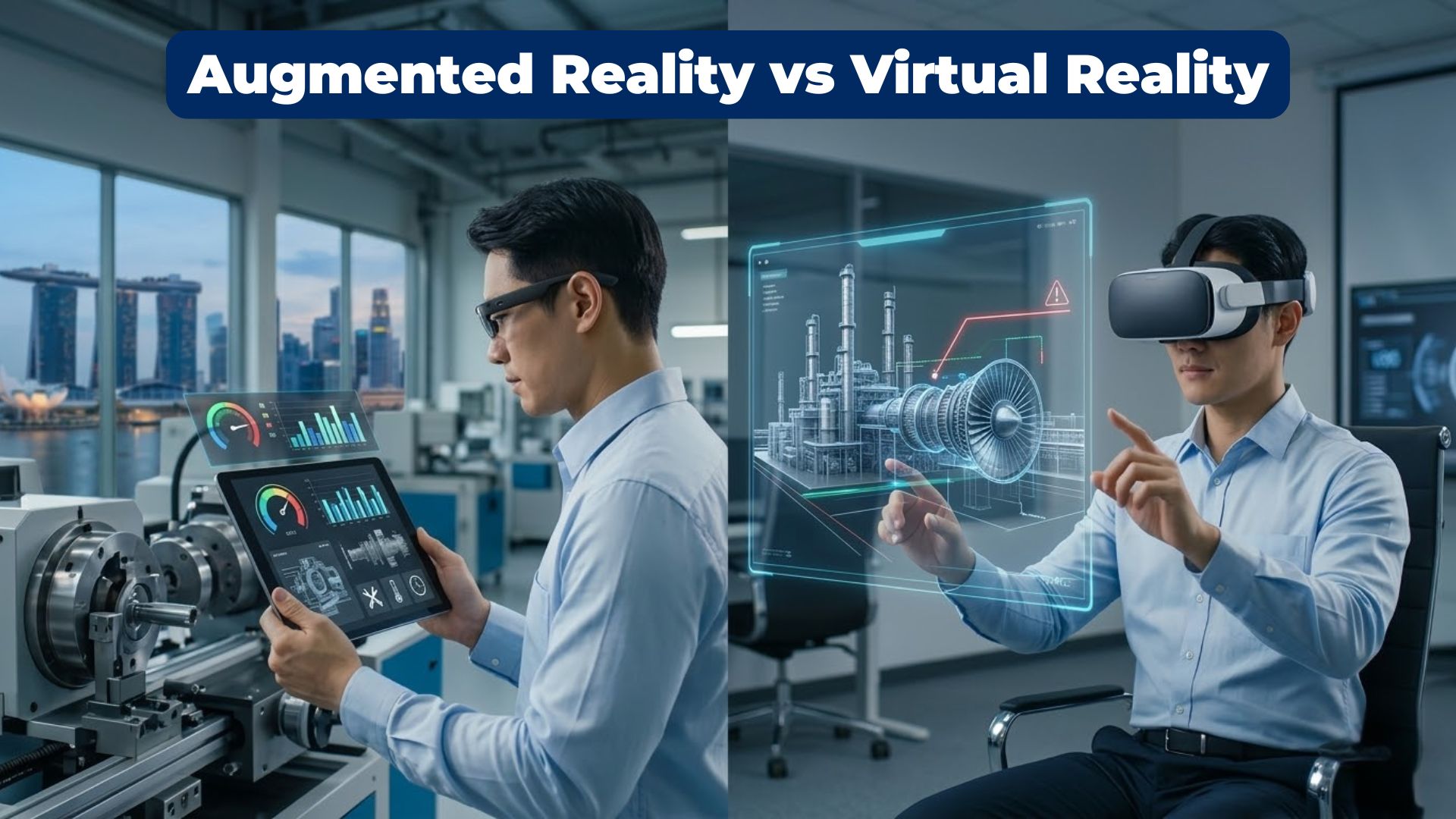
For businesses evaluating immersive technologies, the difference between augmented reality (AR) and virtual reality (VR) comes down to how each technology interacts with the real world. Many organisations do not choose one technology exclusively. Instead, they use VR for preparation and training, and AR for real-world execution.
| Feature | Augmented Reality (AR) | Virtual Reality (VR) |
| Environment | Enhances the real world with digital overlays | Fully immersive simulated environment |
| Typical Hardware | Smartphones, tablets, AR smart glasses | VR headsets |
| Best For | Maintenance, inspections, guided workflows | Training, simulations, design reviews |
| Business Value | Improves real-time decision-making during work | Enables risk-free practice and scenario testing |
AR vs VR for Businesses in Singapore: Key Differences
For most organisations in Singapore, the question is not whether AR or VR is better overall, but which technology solves the operational problem they are facing.
AR tends to deliver the most value when employees are already working with physical equipment or infrastructure. In sectors such as manufacturing, logistics, and utilities, augmented reality allows technicians to see instructions, specifications, and live data directly within their field of view. This reduces errors and speeds up tasks without removing workers from the real environment.
VR, on the other hand, becomes valuable when businesses need to simulate environments that are expensive, complex, or dangerous to replicate physically. Companies use VR to train employees, review facility layouts, or demonstrate projects before construction begins.
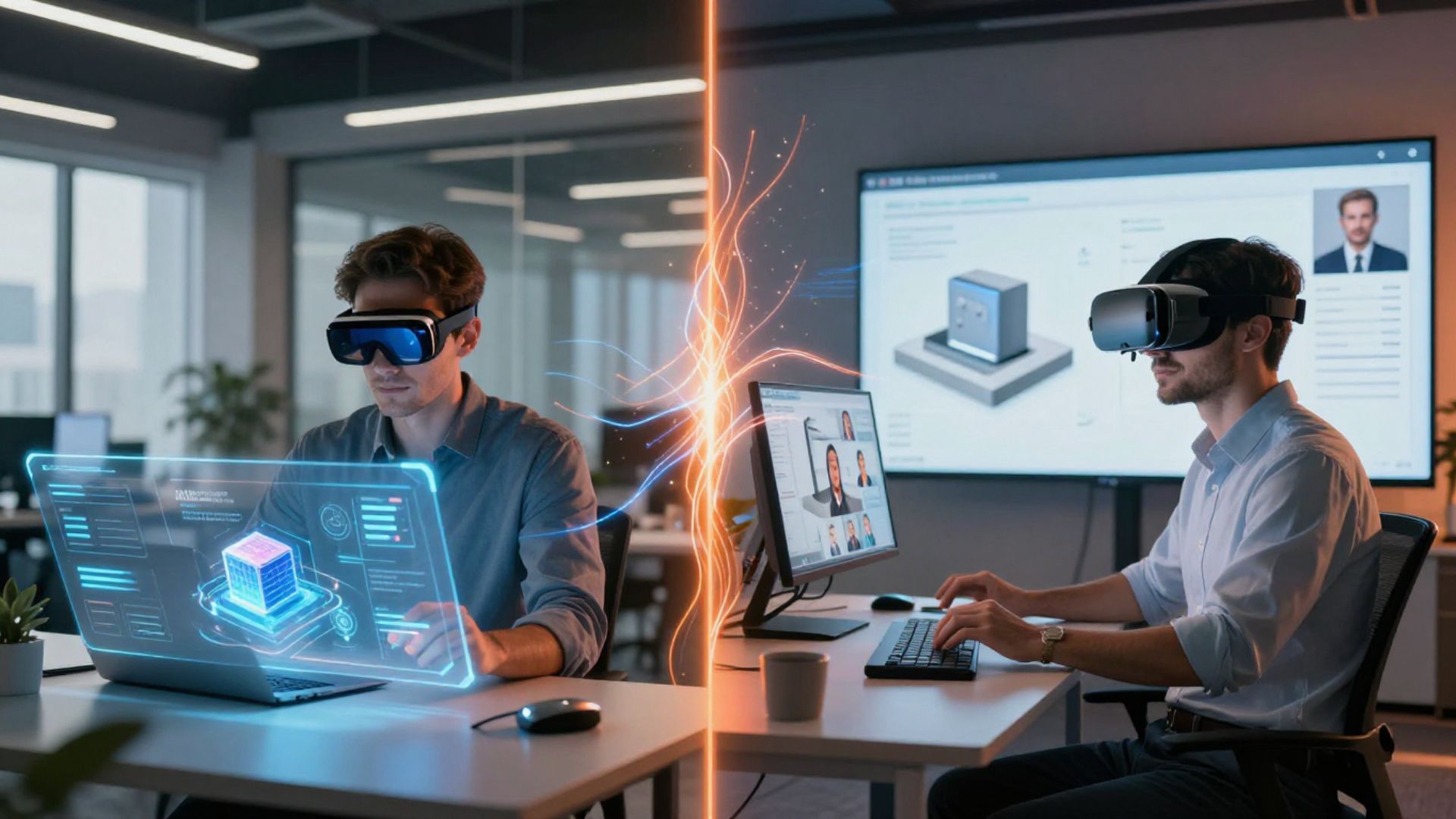
Many Singapore organisations eventually adopt a combined approach. VR prepares employees and stakeholders before real operations begin, while AR supports workers once they are on the job. When used together, the technologies can improve both training outcomes and operational performance across the entire workflow.
How AR and VR Actually Work in Business
Augmented reality, or AR, does not replace the real world; it enhances it.
Information, such as temperature, torque, and history, appears on top of real-world objects via smartphones, tablets, or smart glasses used in the enterprise world. That changes how work happens for technicians.
In many deployments, AR systems connect to live operational data sources. Information can come from ERP systems, IoT sensors, or manufacturing execution systems. AR with proper integration becomes a decision-support tool for frontline workers.
Virtual reality, on the other hand, immerses you in a completely artificial world. Virtual reality allows you to interact with virtual objects, machines, and scenarios, which can be programmed to mimic real-world situations.
Imagine a new technician at a chemical plant. In the real world, a valve failure could mean a toxic leak—a mistake you only get to make once. In VR, that technician can fail a hundred times. They can see the pipe burst, hear the alarms, and practice their emergency shutdown until the sequence becomes muscle memory. They learn the cost of a mistake without paying it.
Some enterprise training programmes have found learners completing modules up to four times faster than with traditional instruction.
The value of AR and VR appears in specific industry workflows.
How AR and VR Are Applied Across Singapore Industries
The difference becomes clearer when companies start using these tools in daily operations.
Manufacturing and Logistics
In Singapore’s manufacturing sector, AR often appears first in maintenance and inspection work.
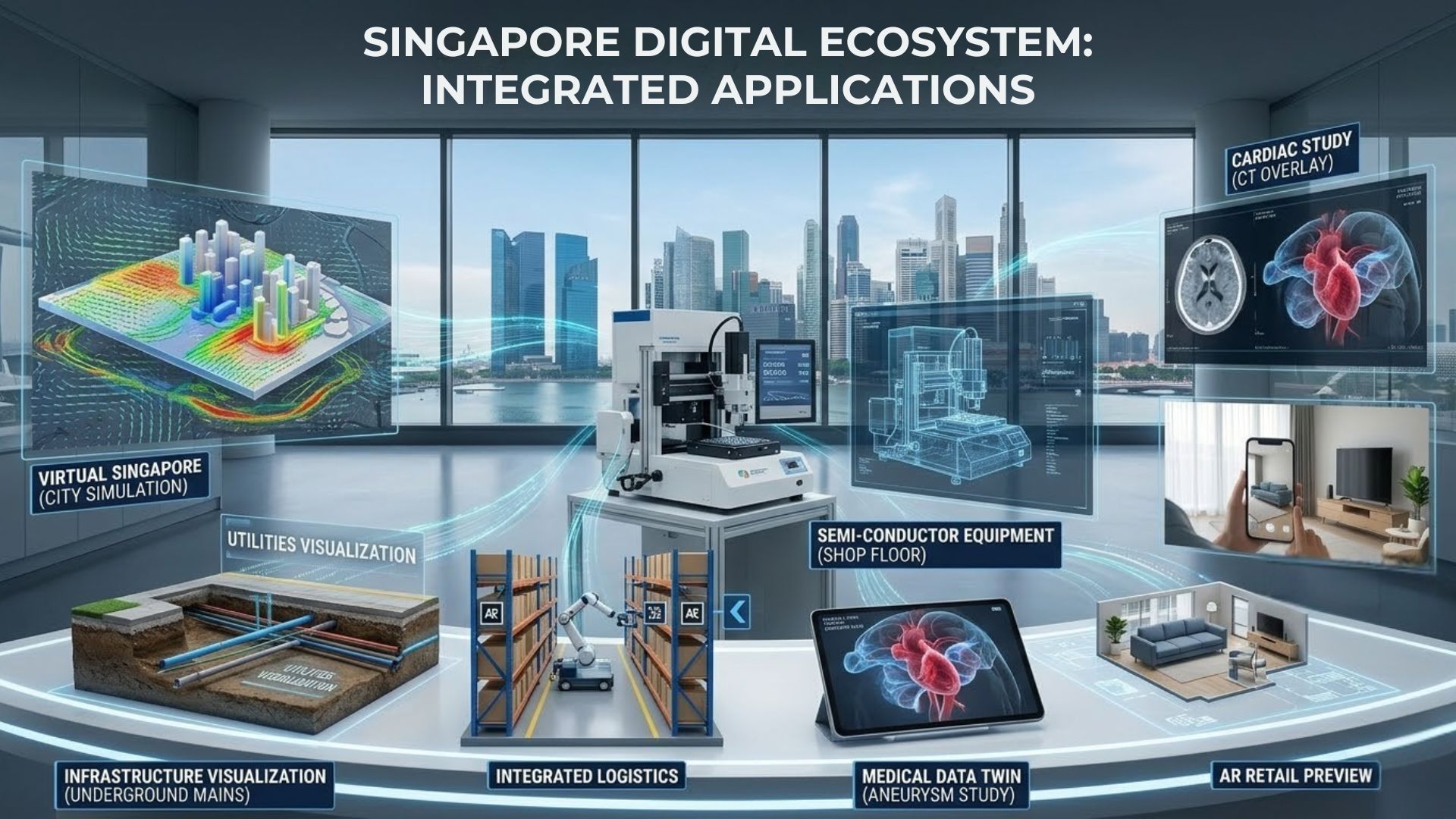
Technicians may wear AR smart glasses while standing beside semiconductor equipment. Labels, torque specifications, and diagnostic data appear directly in their field of view.
You get fewer missed steps and more consistent procedures. Small calibration errors can lead to expensive defects in Singapore's precision engineering and semiconductor sectors.
The same idea appears in warehouse operations.
In logistics, AR-assisted picking systems guide warehouse operators through visual cues toward correct shelves. Workers follow visual instructions instead of checking handheld screens.
Companies report productivity improvements of roughly 15–35% in many deployments.
Before employees reach the shop floor, VR simulations prepare them for equipment operation and safety procedures. But AR assists them during real work.
Healthcare
Virtual reality can be used for training medical students. Equipment behaves realistically, patient scenarios vary, and trainees can repeat procedures without risking real patients.
At Tan Tock Seng Hospital, the MyCare VR programme enables healthcare staff to rehearse blood-taking techniques using simulated experiences. NUS Medicine's MR learning spaces enable students to engage with detailed 3D anatomical models.
AR also appears in clinical workflows. A surgeon could utilize augmented reality to view his patient’s internal organ images before a complex surgery.
Singapore General Hospital has used AR to overlay CT scan data during preoperative planning for complex surgeries.
Retail and Real Estate
Retail introduces a different challenge: helping customers visualise products before they buy.
A customer shopping for furniture online can open their phone's camera and place a product directly in their living room using AR. And places a digital sofa inside their living room. They walk around the space, adjust the angle, and see whether the piece fits before buying. For retailers, this reduces return rates, particularly for large items where logistics costs are high.
An overseas investor can walk through a fully rendered VR apartment, step onto the balcony, and explore shared spaces, all before construction completes.
The selection of whether to use AR or VR depends on the phase of the customer journey. Augmented Reality enables customers to imagine the product in the real world, while Virtual Reality enables customers to imagine the world that has not yet been created.
Smart Cities and Infrastructure
Augmented reality and virtual reality could play a role in the planning of the city.
In Singapore, the Virtual Singapore digital twin, which is a large-scale 3D model of the Singaporean environment, allows for the simulation of various scenarios in relation to urban development.
City planners will be able to utilise this technology to virtually inspect the proposed location, including how much sunlight the building will receive, the wind, and the flow of traffic, including how emergency services will be able to navigate their way to the building.
In a land-scarce country, testing ideas virtually before construction is extremely valuable.
AR tools overlay underground utility lines onto the physical environment during site inspections. Engineers visualise what lies beneath before excavation, reducing damage risk to critical infrastructure.
The discussion becomes practical once you see the applications.
How Should Businesses Decide Between AR vs VR?
So, how do you stop theorising and start deciding?
Forget the technology for a moment. Instead, walk through these four diagnostic questions with your operations team. Your answers will point you toward the right path.
Where is the friction in your workflow?
Is it a lack of information while working? Do your technicians waste time searching for manuals, or do they make decisions based on incomplete data?
This friction occurs within the real world, with the asset right in front of them. You need a tool that enhances their existing reality, overlaying torque specs, IoT data, or step-by-step instructions onto the equipment they’re already looking at. It’s the domain of AR, often delivered via smart glasses or the tablets your team may already be carrying.
Your answer points to AR.
Is it a lack of experience before working? Are your new hires learning on the job, which can slow down production and create safety risks? Is it costing you too much to build physical mock-ups for training?
The friction requires a space where mistakes are free, and scenarios can be repeated on demand. You need to step away from the real world and into a fully simulated environment. This is the domain of VR, delivered through headsets that block out the physical world entirely. Your answer points to VR.
What is your real budget—not just the sticker price?
For AR: The entry cost can be deceptive. If your workforce already uses smartphones or tablets, you might be tempted to think AR is "cheap." But the real investment isn't the screen; it's the plumbing behind it. An AR tool that shows a static PDF is just a fancy PDF. Its value dies the moment the information changes. Your budget needs to account for deep integration with your ERP, IoT sensors, and maintenance databases. The hardware cost may be lower, but the integration cost is where value—or failure—is built.
For VR: It may be a heavier upfront investment. It isn't just buying headsets; it's including specialised 3D content creation, scenario design, and often a longer timeline to get it right. The good news? Once built, the simulation can run thousands of times.
What is the rhythm of the task?
Is the task one that is undertaken every day, with standard steps that need to be followed? (e.g., assembly-line quality control, warehouse picking)
You need a tool that fits into the flow of live work without pulling the worker out of their environment. AR can standardise and speed this up.
Is the task one that occurs rarely, but with high consequences if the outcome is wrong? (e.g., emergency shutdown, complex sales pitch for an unbuilt property)
In that case, the goal is to have a solution that allows for maximum, immersive practice prior to the actual event. For this, the technology of choice is obviously VR, which allows for repeated, risk-free practice.
Who is your user, and what do they concern?
Will AR help a 20-year veteran by putting the latest spec sheet in their eye line, or will it be seen as additional work to them?
Your change management plan needs an answer. The technology works best when it respects the user's expertise.
Will the VR prepare the trainee for the event, or will the technology cause disengagement through motion sickness?
The pilot program needs to test for this. Most advanced simulation is useless if the user can't tolerate the hardware.
Go through these questions honestly. They will tell you if your business needs an AR pilot, a VR build, or—as is often the case—a smartly sequenced combination of both.
VR for the prep, AR for the execution.
What Should Companies Consider Before Implementing AR or VR?

Before signing that contract, have a detailed discussion with your prospective partner about the following three items. Paying attention to these factors is crucial if you don’t want to end up in the boardroom explaining why your pilot failed.
The Integration Trap.
An AR screen that shows a static PDF is just a fancy PDF. Its value dies the moment the information changes. The AR tool also needs to be a window into your live systems, your ERP system, your IoT sensors, and your maintenance database. If the company tells you, 'We'll figure out the API later,' that's a warning sign. You need to figure out the data flow before you figure out the hardware.
The Content Graveyard.
That VR training simulation you're building?
It has an expiration date. When your safety protocols change next year, or you install a new machine, your "immersive experience" becomes a historical artefact.
Ask your vendor: "How do we update this? What platform is it built on? Can our internal team make changes, or are we locked into a costly service contract for every minor edit?"
The cost of keeping the content alive often exceeds the cost of building it.
The Human Factor.
No veteran technician wants a headset telling them how to do a job they've done for 15 years. Your pilot needs a champion, and it shouldn't come from the IT department. Find the most respected, slightly sceptical team lead on the shop floor. Give them the first headset. Let them find the value and tell their colleagues. Adoption is a culture problem, not a hardware problem.
Using AR or VR Is a Strategic Business Decision
The discussion often begins with the technologies themselves. But the real decision usually comes down to operational impact. Most organisations consider how visual information or immersive simulation can remove friction from everyday work.
A clear business objective is often a good start, rather than a fascination with the technology itself. If your organisation is evaluating AR or VR for operations, training, or digital twin planning, the first step is identifying where immersive technology can remove friction from your workflow.
Silversea Media builds intelligent 3D environments that solve exactly these problems—whether it's AR-guided workflows on the factory floor, immersive VR simulations for high-stakes training, or digital twins for smarter planning.
As the technologies become more pervasive in the business world, it is the organisations that can utilise both technologies as a means of improving the way that people work, learn, and make decisions that will benefit the most.