AR vs. MR: Choosing the Right Immersive Technology for Your Business in 2026
You’re in a strategy meeting. Your marketing director is excited about launching an AR-powered product visualisation campaign. Both vendors are promising “immersive transformation.”
If you’ve been researching AR vs MR, you’ve probably noticed how quickly the conversation becomes technical. It’s easy to feel like you understand the surface difference. But not the practical implications for your budget, your teams, and your KPIs.
Here’s the reality. It’s all about business readiness, deployment complexity, and the nature of the outcome you wish to achieve. Quick wins this quarter — or structural transformation over the next two years?
AR vs MR at a Glance
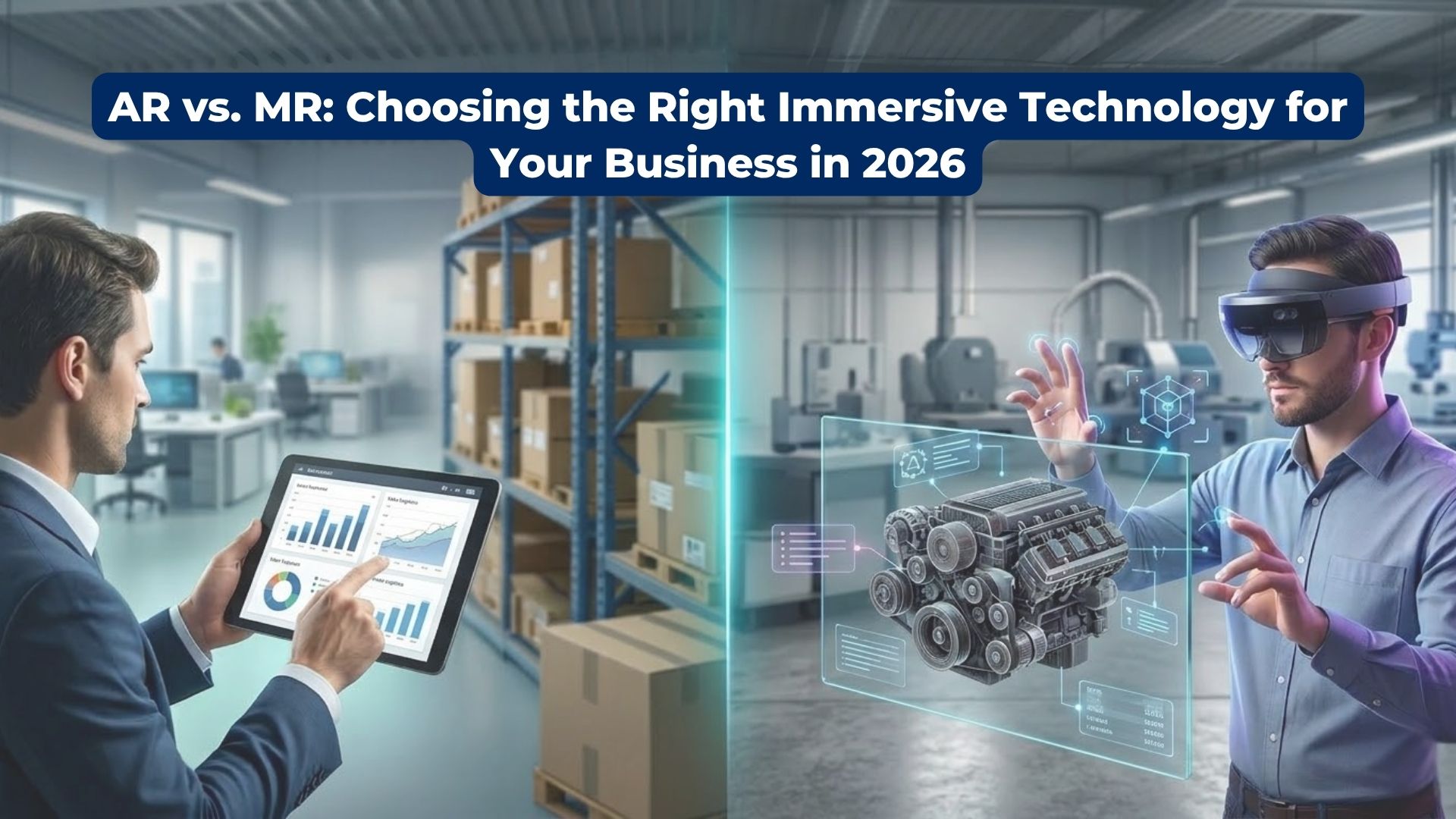
For businesses evaluating immersive technologies, the difference between Augmented Reality (AR) and Mixed Reality (MR) comes down to how digital information interacts with the physical world.
Both technologies blend digital and physical environments, but they operate at different levels of complexity and interaction.
| Feature | Augmented Reality (AR) | Mixed Reality (MR) |
| Environment | Digital content overlays the real world | Digital objects are anchored in the real world and interact with it |
| Hardware | Smartphones, tablets, AR smart glasses | Mixed reality headsets such as Microsoft HoloLens or Magic Leap |
| Interaction | Limited interaction with digital elements | Users can manipulate and interact with 3D digital objects in space |
| Typical Use Cases | Product visualisation, guided workflows, marketing campaigns | Engineering simulation, digital twins, collaborative design |
| Deployment Complexity | Lower — can run on existing consumer devices | Higher — requires specialised hardware and deeper integration |
| Business Impact | Faster customer engagement and frontline efficiency | Deeper operational transformation and simulation capabilities |
In many organisations, AR is the entry point into immersive technology because it can run on devices employees or customers already use.
Mixed Reality typically comes later, when businesses are ready to build spatial applications connected to digital twins, IoT systems, or collaborative engineering workflows.
Rather than choosing one technology permanently, many enterprises treat AR and MR as different stages of an immersive roadmap — starting with scalable AR deployments before introducing MR for high-impact operational use cases.
AR vs. Mixed Reality: Key Differences for Businesses
So, a more basic question to ask is:
How do you want the digital information to behave within your business?
Augmented Reality is like the Heads-Up Display in your car. Critical information, such as your speed, directions, and warnings, is presented to you exactly where you need to see it, within your field of view.
Mixed Reality works differently. It’s closer to placing a working prototype directly into the room with you.
A field service technician is sent to a location to repair a machine. They receive step-by-step instructions within their field of view, alongside the machine they need to repair, using Augmented Reality on a tablet or smart glasses. The technician’s visibility improves instantly.
An engineer reviewing a pump system redesign. With Mixed Reality, a full-scale digital twin of the equipment is anchored in the room. They rotate it, isolate internal components, simulate stress loads, and test airflow dynamics. Colleagues in another country join the same spatial session and annotate the model in real time.
Both technologies connect physical and digital systems. But they serve different priorities.
What you want to achieve is what matters most.
Augmented Reality is more likely to be a good fit if you need to achieve faster visibility, front-line worker engagement, or customer engagement.
If your objective involves simulation, collaborative design, or digital twin integration where spatial interaction changes decisions, MR becomes more relevant.
When leaders search for MR vs AR, they’re often trying to understand which technology sounds more advanced. In reality, the smarter question is this: Do you need to see better — or do you need to simulate, test, and transform?
Your answer determines which path makes strategic sense.
AR vs. MR Use Cases by Industry
Retail & Luxury
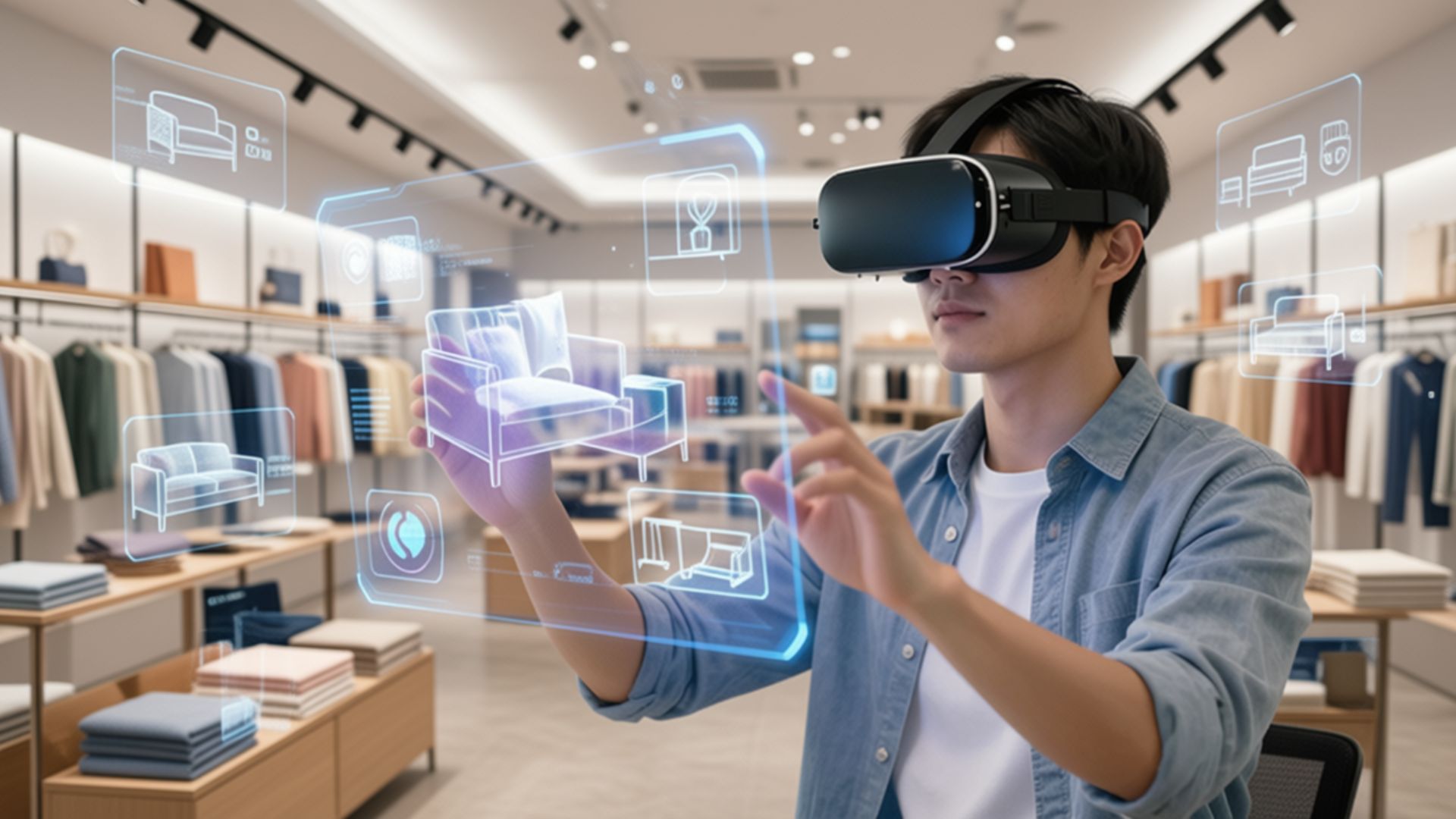
AR: e-commerce visualisation
Instead of asking customers to imagine a product, AR lets them see it. A shopper can place a true-to-scale sofa in their living room using their phone. WebAR removes the need for app downloads, making adoption easy.
For retailers, the impact shows up in the numbers: higher conversion rates and fewer product returns.
MR: immersive showroom
Mixed Reality focuses on premium in-store experiences rather than scale. In a flagship boutique, a full-scale product can appear in front of a customer, anchored in space. They can change finishes, swap materials, or resize elements instantly.
AR improves online shopping quickly. MR creates high-impact brand experiences for complex or customisable products.
Real Estate & Architecture
AR: visualising unfinished spaces
AR helps buyers see what a space could become. Through a phone or tablet, cabinetry appears on bare walls and flooring replaces raw concrete. Virtual staging transforms empty units into finished homes at a fraction of the cost of physical staging.
MR: design coordination and planning
Mixed Reality supports architects and engineers earlier in the project lifecycle. Teams can step into a full-scale building model before construction begins, spotting design conflicts that might be missed in 2D drawings.
If the goal is helping buyers visualise a property, AR is usually the fastest solution. If the goal is reducing construction errors and improving long-term asset management, MR becomes far more powerful.
Manufacturing & Logistics
AR: frontline workflow support
In warehouses or factories, AR adds context to work already being done. A worker wearing smart glasses can see the next item highlighted on a shelf or receive step-by-step instructions during maintenance.
This improves accuracy, reduces errors, and speeds up operations.
MR: facility optimisation
Mixed Reality becomes useful when organisations want to redesign systems. Managers can step inside a spatial digital twin of a facility to simulate layouts, test workflows, and identify bottlenecks before making changes.
AR improves daily operations. MR helps optimise systems and plan future changes.
Healthcare & Education
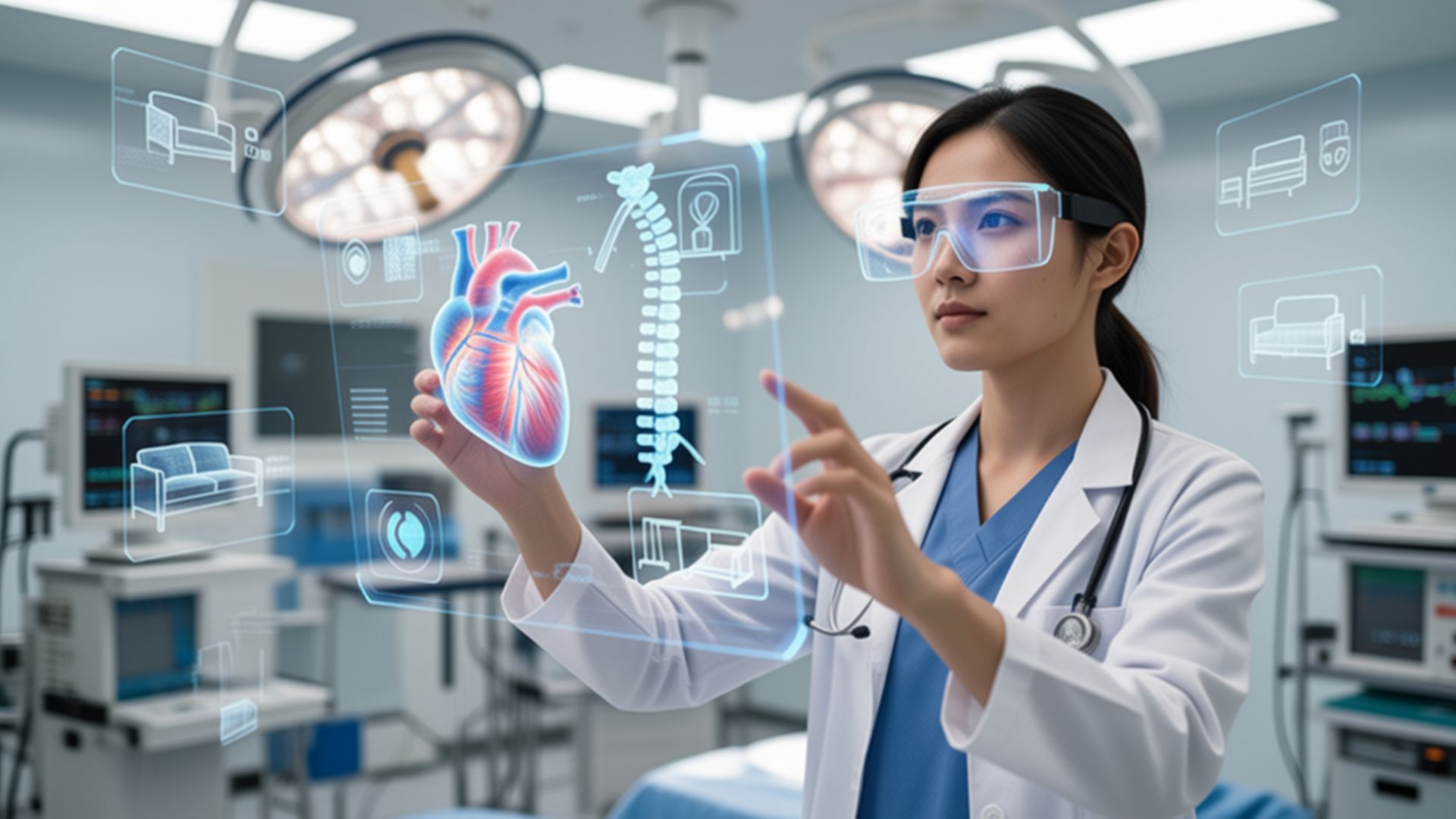
AR: real-time guidance
AR overlays critical information directly within a professional’s field of view. Surgeons, technicians, or trainees can see relevant data without looking away from their work.
MR: immersive training
Mixed Reality enables realistic training simulations. Medical teams can practise procedures, respond to emergencies, and repeat scenarios without risk to patients.
If the goal is delivering information during live work, AR fits naturally. If the goal is immersive training and skill development, MR becomes the stronger tool.
Cost, Complexity, and ROI: Making the Business Case
When you compare Augmented Reality with Mixed Reality, you are not just comparing features, you are comparing budgets, your own internal readiness, procurement lead times, and change management cycles.
If you start with AR, the financial barrier is usually lower and more predictable. MR shifts the equation.
Where AR Tends to Show Returns First
AR often delivers visible impact quickly because it layers onto systems you already use.
In retail and ecommerce, the results are measurable. Outside of retail, the gains become operational.
Virtual staging in real estate has shown significant savings compared to physical staging. For industrial environments, AR-based workflows also show increased productivity gains and reduced inspection time.
Where MR Creates Deeper Operational Impact
MR, on the other hand, tends to justify itself in environments where precision, simulation, and training carry high stakes.
Immersive maintenance and equipment workflows can drive improvement in equipment efficiency and reduction in maintenance costs. Moreover, in training contexts, the impact compounds.
When Digital Twins Enter the Picture
Digital twins are often the reason organisations move from AR into Mixed Reality systems. The financial case becomes even stronger when MR or AR connects to live operational data through digital twins.
Organisations have seen 40% savings in operational costs, 30% faster maintenance cycles, and 65% greater training retention once immersive interfaces are built onto digital twin infrastructure.
Pilot → Measure → Scale
For most organisations, the smartest path isn’t choosing one over the other at the outset.
It’s sequencing.
Start with a contained pilot. Use a specified KPI to measure results, validate internally, and then extend.
Many enterprises take a pragmatic approach to digital twin and MR adoption, using AR as a gateway technology for broad adoption and then layering MR into high-impact applications once the organisation has data maturity and operational readiness to take advantage of MR.
Because ultimately, ROI in the MR vs AR discussion isn’t about which technology promises bigger numbers. It’s about which roadmap your organisation can realistically execute.
AR and MR with Digital Twins: The 2026 Advantage
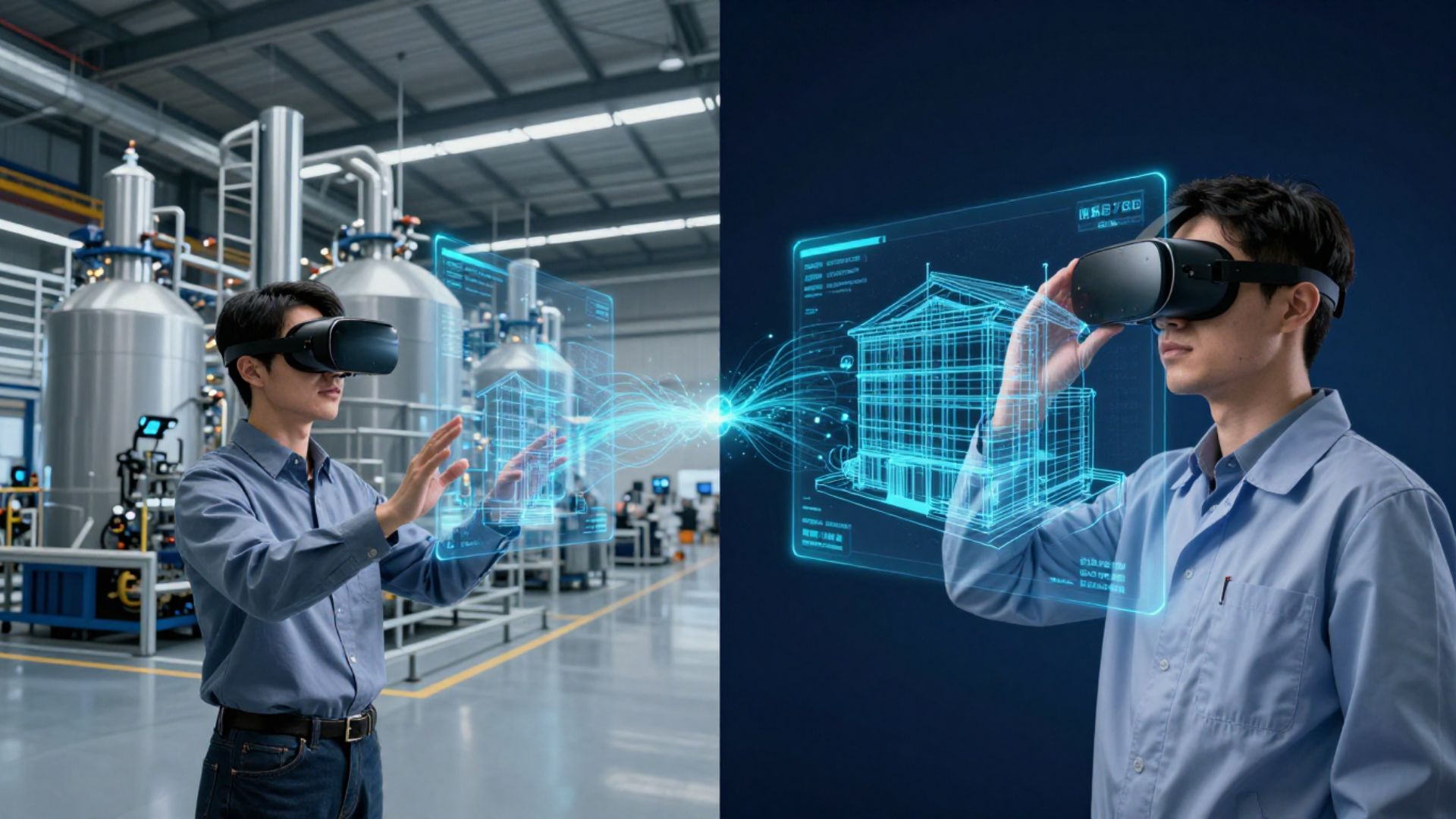
A digital twin is a digital representation of a physical entity, system, or process.
It follows a simple architecture:
- Physical asset with sensors
- Cloud-based twin processing real-time data
- AR or MR interface visualizing and interacting with that data
- MR + Digital Twin for Operational Visibility
When MR connects to digital twins, teams step inside live data. Machines appear as interactive 3D environments with real-time performance metrics.
Focus Areas for Enterprise Leaders
- Enterprise-level integration is a must-have for digital twin technology, which must integrate seamlessly into IoT, ERP, PLM, and analytics technology sets.
- Better decisions with simulation – "What-if" analysis, predictive analytics, and collaborative spatial analysis minimize risks before capital expenditure.
- Real-time data streaming from sensors to the cloud, and then to an immersive interface is also a must-have.
A Strategic Checklist to Choose Between AR and MR
The questions below won't give you a technical answer but a strategic one.
What problem are you actually solving?
If you need information to show up in places where it doesn’t naturally exist, such as a factory floor, a consumer’s living room, or in the midst of a service call, then AR is often the more direct route.
If you need to simulate, test, or collaborate in a way that the physical world just won’t allow. Running "what-if" scenarios, manipulating full-scale prototypes, training for high-stakes situations, MR becomes relevant.
Who is the end user?
If your audience is customers, AR reaches them where they already are. You don’t need a headset and the scale happens quickly.
If your users are employees — engineers, technicians, warehouse teams — you have more control. You can deploy hardware or integrate deeper. But you also carry the cost of training, device management, and change leadership.
How does information need to behave?
Does it need to float in front of someone's eyes and then disappear? That's AR.
If the information needs to anchor to a surface, respond to movement, survive changes in perspective, and allow multiple users to interact simultaneously, MR becomes the better option.
What systems does this need to connect to?
If you're linking to CRM, ecommerce platforms, or marketing analytics, AR integrates cleanly.
If you're connecting to IoT sensors, ERP systems, MES platforms, or digital twins, you're in MR territory.
What scale actually matters?
AR runs on phones already in pockets of countless customers.
But what about a few hundred specialized workers? MR headsets become a capital investment.
AR tends to move faster. Most organisations will need both, just at different stages.
Which outcome you need first is the key here.
Beyond AR vs MR
Your marketing director may want AR-driven campaigns but others’ needs may be different. The language is same — immersive, spatial, real-time — but they're pointing at different horizons.
AR will deliver faster wins. For customer engagement, frontline guidance, and visualising what isn't yet built, it's the pragmatic place to start.
MR will take longer and cost more. But when implemented successfully, it can transform entire workflows. Most businesses don't fail because they chose the wrong immersive technology. They fail because they chose the right technology at the wrong stage of readiness.
This is where an experienced immersive technology partner becomes valuable.
Silversea Media is a Singapore-based deep-tech creative studio working with enterprises across APAC. We help build measurable business outcomes such as customer-facing AR campaigns, guided workflows, and digital twin integrations.
Where will immersive technology create your next competitive edge? And is your organisation ready to deliver on it?
Frequently Asked Questions
What is the difference between AR and Mixed Reality?
Augmented Reality (AR) overlays digital information onto the real world, usually through smartphones, tablets, or smart glasses. Mixed Reality (MR) goes further by anchoring interactive 3D objects in the physical environment, allowing users to manipulate and collaborate with them spatially through specialised headsets.
Is Mixed Reality more advanced than AR?
Mixed Reality is generally more advanced because it enables deeper spatial interaction between digital objects and the physical world. However, AR is often easier to deploy and scale because it runs on devices people already use, such as smartphones and tablets.
When should businesses use MR instead of AR?
Businesses typically use MR when they need spatial simulation, collaborative design, or digital twin integration. It is especially valuable in industries like engineering, manufacturing, and architecture where teams need to interact with full-scale 3D models before real-world deployment.
Can AR and MR work together in enterprise systems?
Yes. Many organisations use AR and MR as complementary technologies. AR often supports frontline workflows or customer engagement, while MR is used for deeper applications such as engineering simulation, immersive training, and digital twin visualisation.